In our guide to setting your virtual assistant rates, one of the reasons to price above your floor was skill scarcity: the harder your work is to replace, the more it is worth. Executive support is one of the clearest examples. If you want to become an executive virtual assistant, the change is not a new set of tools. It is a different kind of responsibility, and it is learnable.
This post covers what changes when you move from general VA work to executive support, the skills that make the difference, and how to build and show them before you have an executive client.
What changes when you become an executive virtual assistant
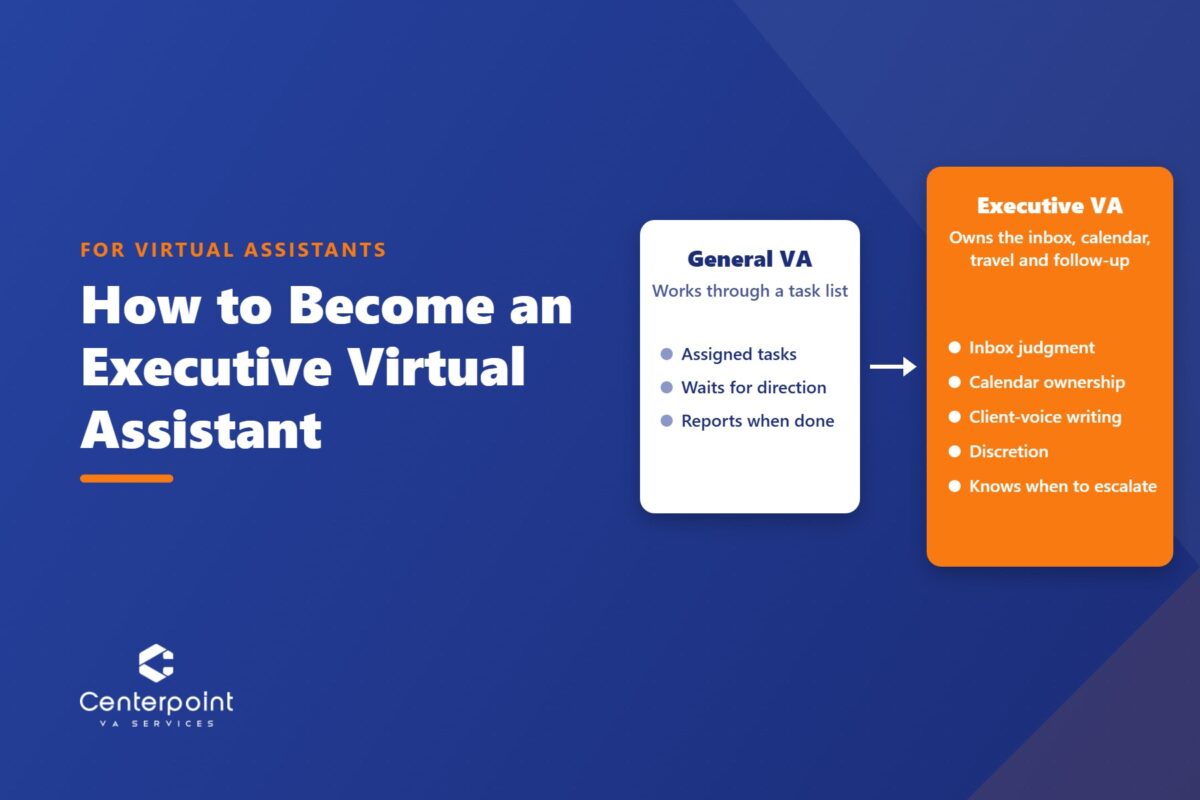
A general virtual assistant works through a task list someone else writes. An executive virtual assistant owns a recurring area of work, such as the inbox, the calendar, travel, and meeting follow-up, and makes routine decisions inside agreed rules without being asked. The client’s question shifts from “did you finish the task?” to “can I stop thinking about this?”
That is a big step up in trust. You see private email, you speak to clients on the executive’s behalf, and you decide what reaches their attention. If you want the client’s side of the picture, read our breakdown of what an executive virtual assistant does day to day. It is a useful description of what you will be expected to own.
The skills that separate an executive VA
Most VAs can already use Gmail, Outlook and Google Calendar. What separates executive support is judgment applied to those tools.
Inbox judgment
You decide what is urgent, what can wait for the daily summary, what you can answer yourself, and what must go to the executive. Getting this right means the executive reads ten messages instead of a hundred, and none of the ten are surprises.
Calendar ownership
You protect focus time, resolve conflicts before they happen, and handle time zones without errors. For Philippines-based assistants supporting US executives, this means thinking in your client’s time zone by default, including daylight saving changes.
Writing in someone else’s voice
Routine replies go out under the executive’s name or yours on their behalf. Clear, short, correct writing that matches their tone is one of the most visible parts of the job, and one of the fastest ways to earn more authority.
Discretion
You will see contracts, personnel issues and private matters. An executive VA treats everything as confidential by default and never discusses one client’s business with another.
Knowing when to escalate
Pricing, hiring, legal commitments and anything that speaks for the executive personally are not yours to decide. Flagging these clearly, rather than guessing, is a skill clients notice. An assistant who escalates too much is still learning; one who escalates too little is a risk.
How to build these skills before your first executive client
You do not need an executive client to practise. You need realistic material and honest review. Five exercises that work:
- Run your own calendar by written rules. Decide your protected hours and booking rules, write them down, and follow them for a month.
- Write a decision-rules page for a made-up executive: who gets a same-day reply, who can book directly, what always gets escalated.
- Triage a mock inbox. Take 30 sample emails, sort them into handle, draft, escalate and archive, and explain each choice in one line.
- Build a full trip itinerary across two US time zones, with flights, hotel, ground transport and a backup option.
- Write a one-paragraph daily summary at the end of each workday, covering what was handled, what is waiting, and what changed.
These build on the habits in our posts on time management systems for remote VAs and the systems to set up before your first client. Keep the outputs. They become your evidence.
How to show it on your resume and in interviews
“Detail-oriented and organized” does not prove anything. Specific examples do. Instead of listing traits, describe the system: “Managed calendar for a team lead across three time zones using written booking rules” says more than any adjective. In interviews, expect scenario questions such as a double-booked meeting, a VIP email at midnight, or a flight cancellation. Walk through what you would decide, what you would escalate, and how you would report it.
Our guide to standing out as a virtual assistant covers the wider profile. For executive roles, the key is to show judgment, not just tool knowledge.
Why executive support supports a higher rate
The rates guide named three factors that justify pricing above your floor: how hard your skill is to replace, how costly the problem you solve is, and how much risk you take on. Executive support scores on all three. Fewer VAs can do it well, an executive’s time is expensive, and a mistake in their inbox or calendar is visible to their clients. That is the case to make when you price executive work. Base it on the responsibility you carry, not on hours alone.
Frequently asked questions
How do I become an executive virtual assistant?
Build judgment on top of general VA skills: inbox triage, calendar ownership across time zones, writing in a client’s voice, discretion, and knowing what to escalate. Practise with realistic exercises such as mock inbox triage and itinerary building, keep the outputs as evidence, and describe specific systems on your resume rather than personality traits.
What is the difference between a virtual assistant and an executive virtual assistant?
A virtual assistant completes assigned tasks. An executive virtual assistant owns a recurring area of work, usually the inbox, calendar, travel and meeting follow-up, and makes routine decisions within written rules without waiting to be asked.
Do I need experience as an executive assistant first?
It helps but is not required. Many executive VAs move up from general VA or administrative roles. What matters is showing the judgment the role needs, which you can practise and document before your first executive client.
Can executive virtual assistants charge more than general VAs?
Usually, yes, because the skill is harder to replace, the executive’s time is costly, and the assistant takes on more risk. There is no single standard rate, so base your price on your own floor and the responsibility the role carries.
Next step
Centerpoint VA Services recruits, trains and supports Philippines-based virtual assistants for US businesses, including executive support roles. If you are building toward this kind of work, see what is open now.