
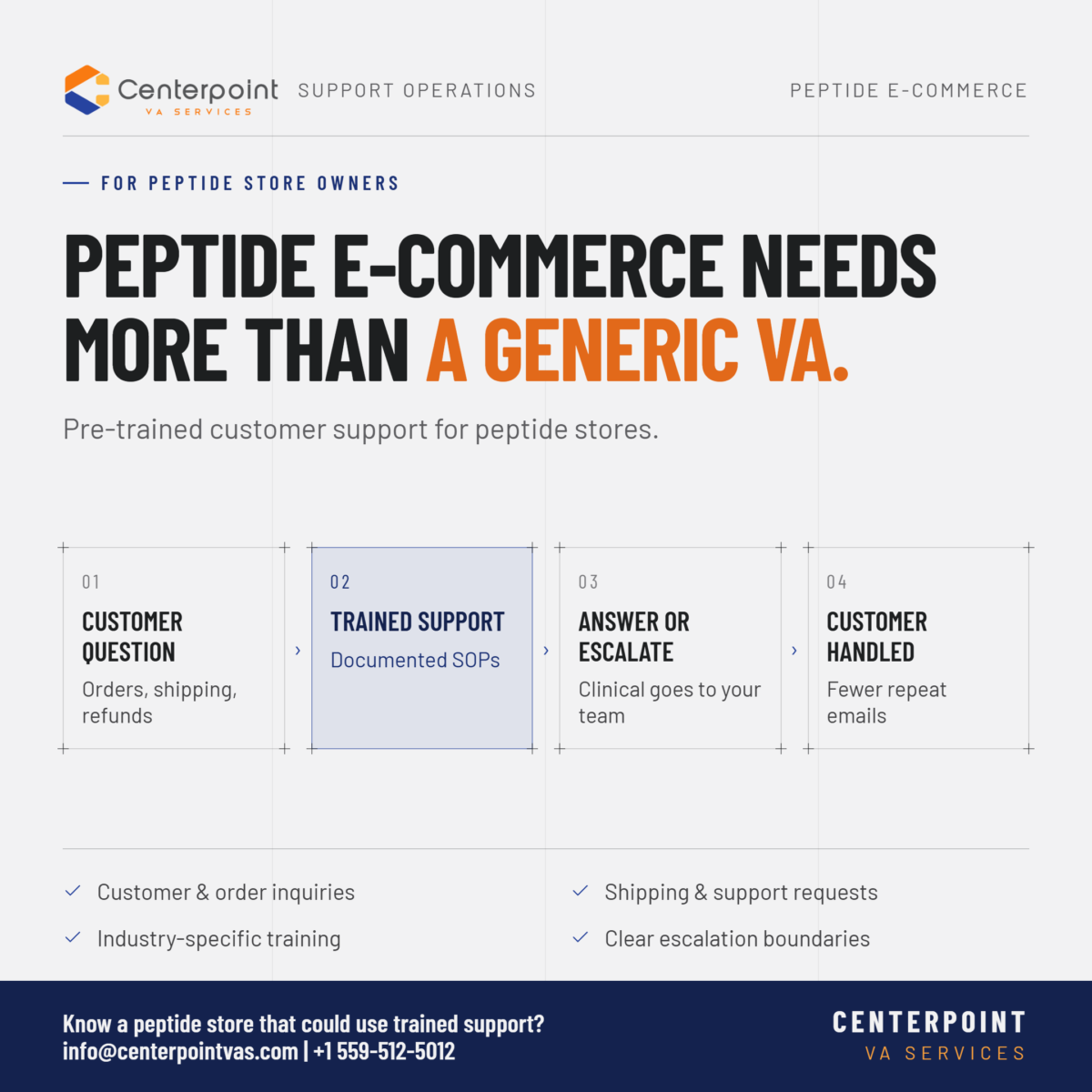
Generic customer support works fine for most online stores. It breaks down fast the moment a brand starts selling anything regulatory-sensitive — peptides, research-use-only (RUO) products, supplements, or other wellness categories where a customer’s question can cross from “where’s my order” into medical or legal territory in a single message.
A support agent who isn’t trained to recognize that line doesn’t just risk a bad review. They risk the brand answering a dosing or health question it was never supposed to answer.
Why Generic Customer Support Doesn’t Work for Regulated Products
Most customer service training focuses on speed and tone: respond fast, stay friendly, resolve the ticket. That’s the right training for a standard e-commerce store — and the wrong training for a peptide, supplement, or RUO brand.
In these categories, the highest-risk tickets aren’t the angry ones. They’re the polite, ordinary-sounding ones: “how much should I take,” “can I combine this with X,” “is this safe for me.” An agent trained only on generic workflows will often just answer — because nothing in their training told them not to. That’s a liability the brand owns, not the agent.
The Escalation-Tier Model We Train VAs On
Centerpoint trains e-commerce support VAs on a strict, two-tier model for regulated and compliance-sensitive categories. The boundary isn’t a judgment call the VA makes in the moment — it’s set in advance, and it doesn’t move.
Handled Directly
Order status, shipping and tracking, returns, account questions, and general store inquiries.
Always Escalated
Dosing, usage instructions, product stacking, side effects, or health suitability. These go to the client’s approved scripts and team, every time — no exceptions and no interpretation by the VA.
The goal isn’t for the VA to become a compliance expert. It’s for the VA to reliably recognize the boundary and route around it, so routine support keeps moving while sensitive questions land with the people qualified to answer them. This is the same model we use on our e-commerce virtual assistant service.
How We Prepare VAs Before They Touch a Live Ticket
A written policy only works if the person following it has actually practiced it. Before a VA supports a regulated e-commerce account, they complete a structured, self-paced training program built specifically for this kind of support — not a generic customer service course with a compliance slide added on.
- A documented Customer Support Response Guide covering exactly what can and can’t be said, in writing, so nothing depends on memory
- Scenario-based practice tickets that specifically test whether the VA correctly escalates borderline questions, not just whether they can resolve easy ones
- A final assessment before certification, so readiness is verified rather than assumed
- Training content that gets revisited and updated as the regulatory environment around these product categories shifts, since it doesn’t stay still for long
This is what “trained, not thrown in” means in practice: the VA has already handled the hard version of the ticket, in a simulation, before they ever see a real customer.
What we don’t do: we don’t claim to guarantee regulatory or FDA compliance, and we don’t position our support as a substitute for your own legal or compliance review. Our job is disciplined, well-documented customer support — not legal or medical advice, and not a replacement for the escalation scripts and approvals your team owns.
What to Look for in an Outsourced Support Partner for Regulated Products
If you’re evaluating outsourced support for a peptide, supplement, or other regulated e-commerce brand, a few questions separate a real answer from a generic pitch:
- Is the escalation policy written down? If it only exists as a verbal understanding, it won’t hold up once the team scales past one or two agents.
- Can they show you the training, not just describe it? Ask to see the actual materials — the response guide, the practice scenarios — not a summary of them.
- Do agents get tested on borderline cases before going live? Handling the easy tickets well doesn’t tell you anything about the hard ones.
- Is there a clear, stated boundary on what the VA will and won’t say to a customer? If the answer is vague, assume the boundary is too.
Frequently Asked Questions
Can a virtual assistant support a peptide or RUO e-commerce store?
Yes, when the VA is trained on a clear escalation model. They handle routine support — orders, shipping, returns, account questions — directly, and route anything touching dosing, usage, or health claims to the client’s own approved scripts and team.
What’s the difference between order support and a dosing question?
Order support covers the logistics of a purchase: status, tracking, returns, billing. A dosing or usage question touches how a customer uses the product, which is exactly the category that gets escalated rather than answered by support.
How is this different from hiring a general customer service VA?
A general VA is trained to resolve tickets quickly. A VA supporting a regulated e-commerce brand is trained to first recognize which tickets shouldn’t be resolved by support at all — and to escalate those correctly, every time.
How quickly can a trained VA be in place?
After a discovery call to understand your platforms and escalation requirements, we typically shortlist candidates within days. Exact timelines depend on your specific setup.


