A brand handing customer support to a virtual assistant is really asking one question underneath everything else: what happens the first time a VA who has never touched this account before gets a real customer message? For a peptide, supplement, or RUO brand, that question carries more weight than it does for a typical online store, because the wrong first reply can create exactly the kind of risk a generic support hire was never trained to avoid. Centerpoint VAS answers that question with a defined peptide support VA certification process a VA has to complete — not just get hired into — before they’re ever assigned to a live regulated e-commerce account. Here’s what that process actually involves.
Peptide support VA certification means passing something, not just finishing
Plenty of support vendors describe “training” as a video a new hire watches once. Centerpoint VAS built its regulated e-commerce program to work differently: a VA has to pass a defined assessment and a hands-on simulation before they’re certified, not simply sit through material. That distinction matters because a training program with no pass/fail gate tells a buyer what a vendor covered, not what any individual agent actually retained.
Inside the 9-part training program
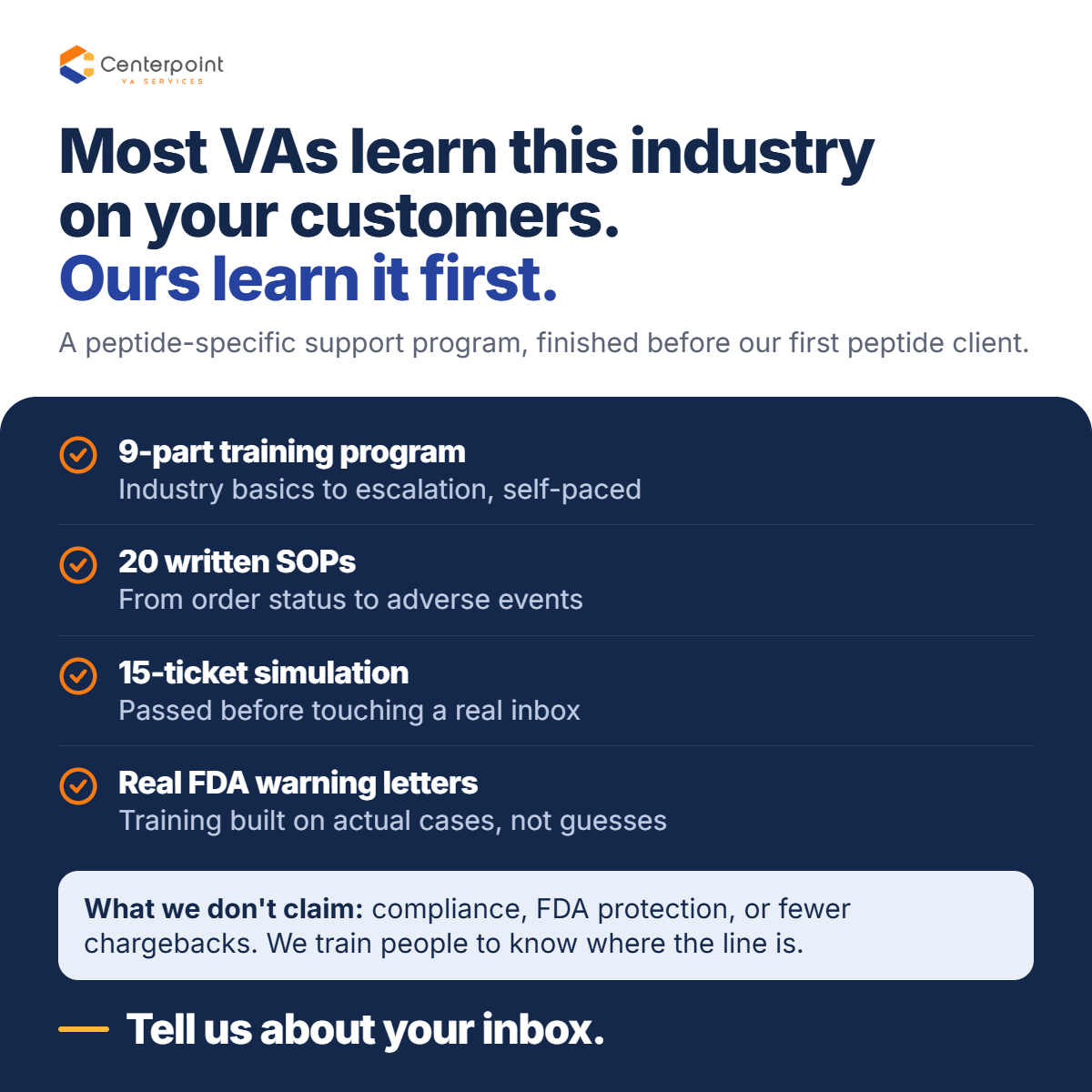
Every peptide and regulated e-commerce support VA works through a 9-part self-paced training program built specifically for this niche — not a repurposed general customer service course. It draws on 11 source documents covering the product category, escalation rules, and platform-specific handling, paired with video scripts and an activity and quiz set for each module. Supporting materials include a dedicated Customer Support Response Guide and a Job Readiness Standard that defines what “ready” actually looks like before a VA can move on to assessment. The full material set runs to 34 PDFs, produced in two versions — a trainee copy and a separate trainer-only copy — so answer keys never end up in a trainee’s hands before they’re tested.
The 50-question final assessment
Once a VA finishes all 9 modules, they sit a 50-question final assessment covering the material directly — escalation triggers, platform-specific rules, and what agents are trained never to say to a customer. A VA who can’t demonstrate mastery on the assessment doesn’t move forward to the next stage, regardless of how much of the material they’ve already been through.
The 15-ticket capstone simulation
Passing a written assessment proves a VA knows the rules. It doesn’t prove they can apply those rules under the actual conditions of a live ticket queue. That’s what the 15-ticket capstone simulation is for: a set of realistic support scenarios a VA has to work through and get right before certification is considered complete.
What the capstone simulation tests
- Recognizing a dosing or usage question and escalating it correctly instead of answering it directly
- Handling platform-specific situations differently depending on whether the account runs on Shopify or WooCommerce
- Applying the response guide’s language for sensitive topics without improvising new wording
- Knowing when a ticket needs a designated reviewer rather than a standard reply
- Documenting a ticket correctly so the next person who touches it has full context
Why this level of readiness matters specifically for regulated brands
A support agent who improvises on a peptide, supplement, or RUO account isn’t just risking a bad customer experience — they’re risking exactly the kind of response that creates platform or regulatory exposure for the brand behind them. Centerpoint VAS built the certification process around one assumption: the first live ticket a VA handles should never be the first time they’ve practiced handling one. That’s the entire purpose of the capstone. By the time a VA is certified, they’ve already worked through the hard cases in a simulation, not on a real customer’s account, and a designated reviewer has already checked their judgment against the standard the brand expects.
What a brand can expect once a certified VA joins their account
Certification is the gate before a VA is assigned, not the end of oversight. Escalated tickets continue to route to a designated reviewer on a live account, and the same response guide and escalation triggers a VA was tested on in the capstone stay in place as the standard they’re held to going forward. A brand bringing on a Centerpoint VAS support VA isn’t just getting someone who finished a course — they’re getting someone who had to prove they could apply it before being trusted with a real customer conversation. Learn more about how this fits into full support staffing on our e-commerce virtual assistant support page.
Frequently Asked Questions
How does a VA get certified to support a peptide, supplement, or RUO brand at Centerpoint VAS?
A VA completes a 9-part self-paced training program built specifically for regulated e-commerce support, passes a 50-question final assessment, and completes a 15-ticket capstone simulation. Only after passing all three stages is a VA certified to work a live account.
What does the capstone simulation actually test?
The 15-ticket capstone simulation tests whether a VA can correctly recognize and escalate dosing or usage questions, apply platform-specific handling for Shopify versus WooCommerce, use approved response language for sensitive topics, and document tickets correctly — under conditions that mirror a real support queue.
Does finishing the training modules alone qualify a VA to work a live account?
No. Centerpoint VAS also requires a VA to pass the 50-question final assessment and the 15-ticket capstone simulation. Finishing the training material is a prerequisite for certification, not the same thing as being certified.
Does certification mean a VA works without oversight once assigned to an account?
No. Escalated tickets continue to route to a designated reviewer after certification, and certified VAs are held to the same response guide and escalation triggers they were tested on during the capstone simulation.
Book a Discovery Call to see Centerpoint VAS’s full training and certification program in detail.