
A peptide, supplement, or RUO brand can have a well-written support policy sitting in a document somewhere and still fail the moment a real dosing question lands in the inbox. Policy on paper and a support agent’s actual next move under time pressure are two different things. The most useful way to evaluate a support vendor isn’t to ask whether they have an escalation policy — almost everyone claims one. It’s to walk through exactly what happens, message by message, when a customer asks a dosing or usage question. Here’s how peptide support escalation actually plays out inside Centerpoint VAS’s trained process, step by step.
The ticket comes in
A customer — call them a composite, illustrative example rather than any real account — messages support through a help desk ticket or chat widget: “How much of this should I be taking, and how often?” On the surface it looks like a routine product question, the same shape as “does this ship with a scoop” or “what’s your return window.” That similarity is exactly what makes it dangerous to leave to agent instinct. A support agent who treats every message as the same category of question is the failure point regulated brands need to design around.
The 30-second trigger check that starts peptide support escalation
Centerpoint VAS trains every support VA to run a trigger check before typing a single word of reply. The question gets matched against a defined list of trigger categories — dosing, frequency, stacking with other products, expected effects, or anything that reads as usage guidance — rather than left to the agent’s read of tone or context. If it matches, the ticket is escalated immediately. There is no gray-area judgment call happening in the moment, because the judgment call was already made in advance, during training, not improvised live on a real customer’s ticket.
What the agent says — and doesn’t say
The agent does not answer the dosing question, restate it back with a caveat, or offer a “general guideline.” All three of those are common mistakes support teams make because they feel more helpful in the moment than a flat redirect. Instead, the agent sends a scoped response that acknowledges the question, explains that usage guidance isn’t something support can provide directly, and gives the customer a clear next step.
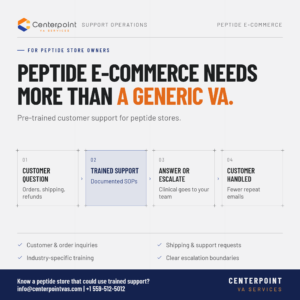
The three-line response VAs are trained to give
- Acknowledge the question directly, without dismissing it.
- State plainly that dosing and usage guidance falls outside what customer support can answer.
- Point to the next step — product documentation, a qualified resource, or escalation to a designated reviewer — rather than leaving the customer with nothing.
The handoff to review
Behind the scenes, the ticket doesn’t just sit closed. It’s flagged and routed to a designated reviewer — a role Centerpoint VAS trains as part of its escalation structure — who confirms the response matched protocol and checks whether the ticket needs any further follow-up. This review layer exists specifically so that an escalation isn’t just “agent sends canned line, ticket forgotten.” Every escalated ticket gets a second set of eyes before it’s considered closed.
Closing the loop with the customer
If the brand has a designated resource for usage questions — a compliance contact, a formulator, or documentation the brand has approved for this purpose — the follow-up points there. If no such resource exists, the ticket stays flagged as an open gap rather than being closed out as resolved, because an unanswered customer question that gets marked “resolved” internally is its own kind of risk. The goal isn’t to make the ticket disappear. It’s to handle it correctly and leave a clean record of how it was handled.
Why this walkthrough is the real product
This exact sequence — trigger check, scoped response, escalation, review, documented follow-up — is what Centerpoint VAS’s 9-part regulated e-commerce training program is built to produce automatically, not something agents figure out case by case. Every support VA has to pass a 50-question final assessment and a 15-ticket capstone simulation that includes scenarios exactly like this one before they’re allowed to touch a live account. The capstone exists precisely so that the first time an agent handles a real dosing question isn’t the first time they’ve practiced handling one. When evaluating a support vendor, this is the level of detail worth asking for: not “do you have a policy,” but “walk me through exactly what your agent does in the first thirty seconds.” Learn more about how this fits into full support staffing on our e-commerce virtual assistant support page.
Frequently Asked Questions
What happens when a customer asks a dosing question through Centerpoint VAS’s support process?
The support agent runs a trigger check, identifies the question as a dosing or usage question, and does not answer it directly. Instead, the agent sends a scoped response acknowledging the question and pointing to the correct next step, while the ticket is escalated to a designated reviewer.
Does a Centerpoint VAS support agent ever give a “general guideline” answer to a dosing question?
No. Agents are trained not to offer a general guideline, a softened version of the answer, or a caveated restatement of the question. Any question that matches the dosing or usage trigger list is escalated rather than answered in any form.
Who reviews an escalated dosing question ticket?
A designated reviewer checks every escalated ticket to confirm the response matched protocol and to determine whether further follow-up is needed. This review step is part of Centerpoint VAS’s trained escalation structure, not an optional or occasional check.
How are Centerpoint VAS support VAs trained to handle scenarios like this before working a live account?
Every support VA completes a 9-part self-paced training program, passes a 50-question final assessment, and completes a 15-ticket capstone simulation that includes dosing and usage escalation scenarios, before being assigned to a live client account.
Book a Discovery Call to see Centerpoint VAS’s full escalation protocol and training program in detail.