

Outsourcing peptide customer support — or support for a supplement or RUO (research-use-only) brand — is a different decision than outsourcing support for a typical e-commerce store. The products sit closer to regulatory attention, the customer questions get more sensitive, and a single mishandled reply can create risk that a generic support vendor was never built to manage. Before signing with any support provider, a peptide or supplement brand owner should be asking specific, pointed questions — not just comparing hourly rates. Here’s the checklist Centerpoint VAS recommends running through first.
Before outsourcing peptide customer support, start with escalation protocol
The first question shouldn’t be “how much does it cost.” It should be “what happens when a customer asks a dosing or usage question.” A vendor that answers vaguely, or says their agents “use their best judgment,” is telling you they don’t have a real escalation protocol. The answer you want to hear is specific: a defined trigger list of question types that get routed away from direct response, a named escalation path, and a policy that’s written down rather than left to individual agent discretion.
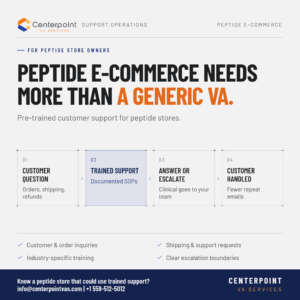
Ask exactly how agents get trained before touching your account
“We train our agents” is not an answer — it’s a claim. Ask what the training actually consists of: how many hours, what material, whether there’s an assessment, and whether an agent has to pass something before being allowed on a live account. Centerpoint VAS built a 9-part self-paced training program specifically for regulated e-commerce support, including a 50-question final assessment and a 15-ticket capstone simulation that every support VA has to pass before working a real client ticket. That’s the level of specificity worth asking for from any vendor, not just us.
Check whether the vendor understands your platform’s specific rules
Shopify and WooCommerce create different support risks — what’s safe to say in a WooCommerce help desk ticket isn’t automatically safe in Shopify Inbox, since Shopify’s own systems can see that conversation. A vendor that hasn’t thought about this distinction is a vendor that’s learning it on your account. Ask directly whether they’ve supported your specific platform before and whether their agents are trained on platform-specific guardrails, not just general customer service. Centerpoint VAS breaks down the platform-by-platform differences in detail in Shopify vs. WooCommerce customer support for regulated e-commerce brands.
The core questions to ask before signing
- What exact triggers cause a ticket to be escalated instead of answered directly?
- How are agents trained and certified before touching a live account, and is there an assessment?
- Has the vendor supported this specific platform (Shopify, WooCommerce, or other) before?
- Who reviews escalated tickets, and how fast is the turnaround?
- What do they explicitly refuse to say to a customer, and is that refusal list written down?
Ask about oversight, not just execution
A support VA answering tickets is only half the picture — ask who reviews their work, and how often. Get specific about whether escalated tickets are reviewed by a second person before a reply goes out, how quickly a flagged ticket gets a response, and what happens if an agent makes a mistake. A vendor with a real quality process will describe a review layer without being asked twice; a vendor without one will describe the agent’s own judgment as the entire safeguard. It’s also worth asking what a trial period looks like and whether you retain the right to review ticket logs directly — a vendor confident in their process won’t hesitate to offer both.
What a strong answer sounds like versus a red flag
A strong answer names specifics: a defined training program, a named escalation contact, a documented list of what agents won’t say. A red flag answer stays general: “our team is experienced,” “we handle sensitive topics carefully,” “we’ll figure it out as we go.” For a regulated or compliance-sensitive brand, the second kind of answer is the one that costs a brand its platform standing or its customers’ trust. The restraint a vendor shows in what they won’t claim is often a better signal than what they will claim. Centerpoint VAS builds its own peptide and supplement support positioning around exactly that restraint — being specific about what agents are trained to do, and equally specific about what they’re trained not to do. That foundation is laid out in our overview of customer support for regulated e-commerce brands, and the staffing model itself is described on our e-commerce virtual assistant support page.
Frequently Asked Questions
What’s the most important question to ask before outsourcing customer support for a peptide or supplement brand?
Ask what happens when a customer asks a dosing or usage question. The answer should describe a specific, written escalation protocol — not “agents use their judgment.” Centerpoint VAS treats this as the single highest-signal question a buyer can ask.
Should I ask a support vendor about their training program before signing?
Yes. Ask how many training hours, what material is covered, and whether agents pass an assessment before touching a live account. Centerpoint VAS requires every support VA to complete a 9-part training program and pass a 50-question final assessment plus a 15-ticket capstone simulation first.
Does the e-commerce platform (Shopify vs WooCommerce) matter when choosing a support vendor?
Yes. Shopify support work happens partly inside Shopify’s own visible tools, like Shopify Inbox, while WooCommerce support runs through a separately configured help desk stack. A vendor should be able to explain how their agents handle each platform differently, not treat all platforms the same.
What’s a red flag when vetting a customer support outsourcing vendor for a regulated brand?
Vague, general answers are the red flag — phrases like “our team is experienced” or “we handle sensitive topics carefully” without specifics. A vendor confident in their process will name their training program, their escalation triggers, and what agents are explicitly instructed not to say.
Book a Discovery Call to walk through Centerpoint VAS’s escalation protocol and training program in detail.

